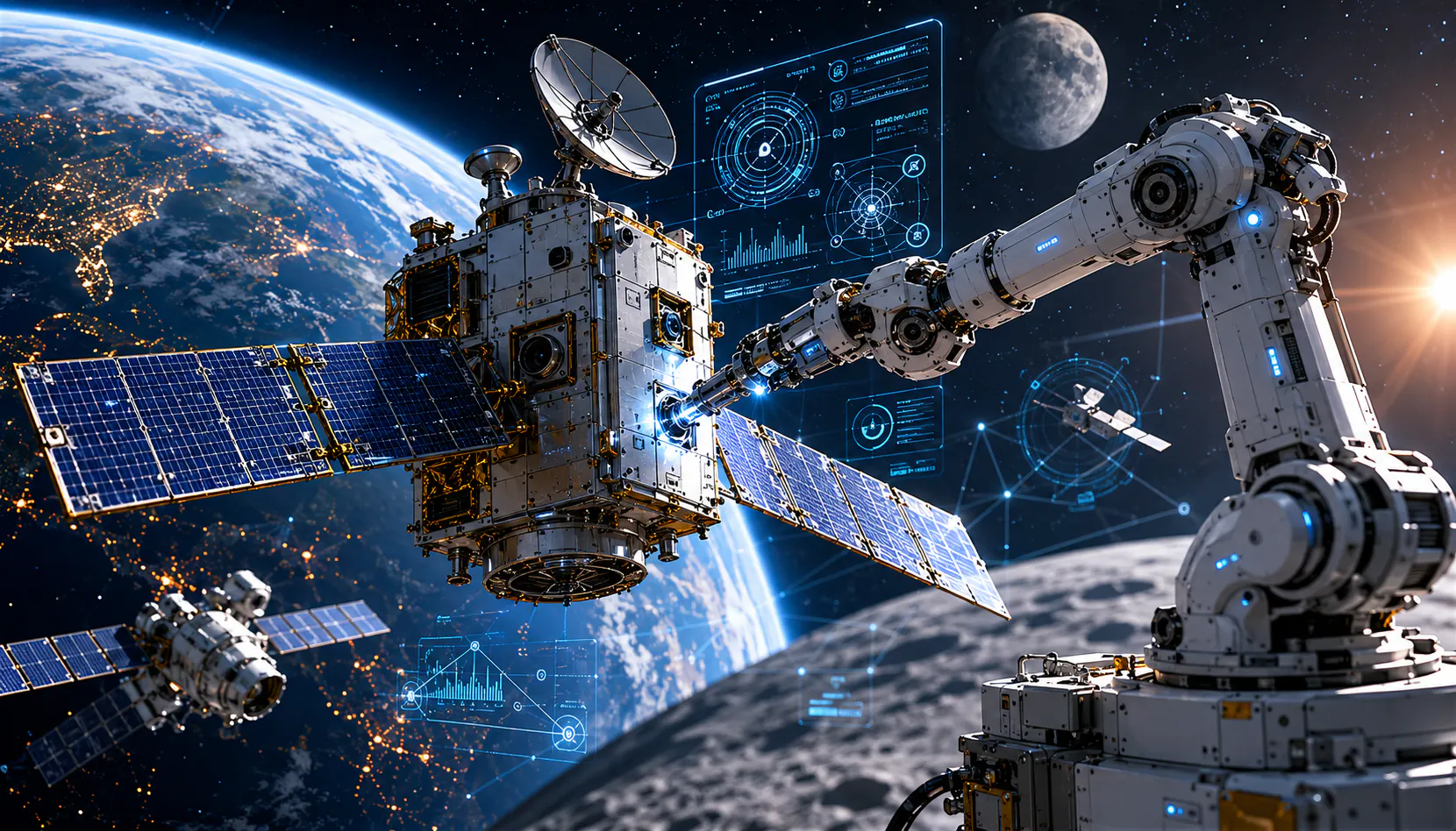
In the growing knowledge economy, otherwise known as Industry 4.0, space is learning to operate alone. Far above Earth, satellites are already beginning to make decisions without waiting for human instruction. Some space systems can now avoid collisions autonomously, while others can dock ton or inspect neighbouring spacecraft, reposition themselves, or manage orbital traffic with minimal intervention from the ground. Around the Moon, future stations may spend months operating without astronauts onboard at all.
This marks a subtle shift in the character of space activity, where for decades, space missions depended almost entirely on constant human supervision. Previously, every maneuver required direct human oversight from Earth, but as operations expanded farther into orbit and beyond, that model became increasingly impractical. Distance, especially in the realm of space, does change everything.
A spacecraft operating near Mars cannot wait for real-time instructions because communications delays make immediate control impossible. Even within cislunar space (which is the region between Earth and the Moon) systems must be able to respond independently to hazards and other systems or equipment anomalies. In the dynamic environment of outer space, such failures are common and expected. Autonomy therefore represents technological convenience, and is becoming a topic of operational necessity.
Modern satellites use autonomous navigation systems to maintain orientation, which is particularly useful in the case of megaconstellations, containing thousands of spacecraft which now rely heavily on automated coordination simply to remain operational. Without this level of machine-assisted management, orbital congestion would otherwise become untenable, and quickly at that.
Through this quiet transformation, AI and robots are beginning to reshape how infrastructure functions in orbit. Companies such as Starfish Space are developing spacecraft capable of autonomously approaching and servicing satellites that are already in orbit. NASA and several private operators are testing robotic inspection systems designed to extend satellite lifespace and support long-duration missions, in addition to helping reduce debris proliferation overall. Rather than replacing spacecraft entirely once fuel runs low, future systems may in future simply be repaired, repositioned or refuelled directly from space. We begin to see the profound impact of autonomous operations when autonomy itself can shape the economics of space operations.
Gone are the days when spacecraft were treated as disposable assets. Historically, spacecraft were expensive and hard to build. Autonomous servicing however, introduces the possibility of
maintaining infrastructure over far longer periods. A satellite may no longer represent a single-use machine, but form part of a continuously managed orbital ecosystem. The same goes for spacecraft operating beyond low Earth orbit.
NASA’s Lunar Gateway, planned for lunar orbit later this decade is designed to function largely autonomously between crew visits. Unlike the International Space Station (ISS) which depends heavily on continuous astronaut presence, Gateway will rely instead on robotic systems helping to manage remote operations across much greater distances. The Moon itself may soon become a proving ground and thereafter a hotbed for autonomous infrastructure.

Future lunar missions are expected to involve a wide-range of applications such as robotic cargo delivery, autonomous construction systems, and AI supported surface operations that will pave the way for development before humans are able to establish a sustained presence. Several space agencies are already experimenting with robotic excavation technologies capable of extracting lunar materials without direct human control.
But such innovation does not come without its tensions. The same technologies that allow spacecraft to dock and service satellites can also enable inspection, shadowing and in the worst case, interference with rival assets. Rendezvous and proximity operations, often referred to as RPO, occupy an ambiguous space between civilian servicing capability and military utility. That is to say, a spacecraft that is capable of repairing another satellite, may also theoretically disable one as well, creating a number of governance challenges.
Existing international space law was largely written during an era when spacecraft were relatively passive objects following predictable trajectories. Autonomous systems challenge many of those assumptions. Questions surrounding accountability and transparency for machine-based decision-making are becoming more urgent as AI-driven operations expand into orbit. In light of this the following questions arise. Who then bears responsibility if an autonomous spacecraft collides with another object? How should operators communicate autonomous maneuvers in crowded orbital environments? What happens when military and civilian systems use similar technologies for entirely different purposes. Unfortunately these questions remain largely unanswered.
The challenge is further amplified by the growing scale of orbital activity itself. According to OECD and United Nations assessments, Earth orbit may host tens of thousands of additional satellites before the end of the decade. Human operators alone cannot realistically coordinate this level of complexity in real time, therefore orbital management may depend on AI systems communicating with one another as a general mainstay. They will also be able to achieve real-time communication faster than humans would be able to respond. A strange paradox ensues, where the future of the space economy may be hinged on machines operating beyond human oversight, while still requiring human trust and legal accountability. It stands to be seen whether such a scenario will bode well for the future of international coordination, where enforcement remains an issue.
How this will play out in humanity’s psyche where exploration has commonly been understood as something humans physically undertake themselves, stands to be seen. Autonomous space operations blur that distinction, as machines become active participants in navigating the next frontier. In some respects, the first permanent inhabitants of deep space may not be astronauts at all, but autonomous systems working continuously in the background.
The rise of autonomous space operations is as complex as the topic of space exploration itself. What is clear however is that autonomy is embedded within satellite constellations, lunar infrastructure, servicing missions and future deep-space operations alike. The next chapter of space development may therefore depend not only on where humanity travels, but on what humanity builds to operate there long after direct human control becomes impossible.