The geography of the space economy has been well-defined for decades. For the most part, everything that mattered has been taking place primarily in low Earth orbit (LEO), be it satellites, data and even human and robotic missions. Beyond that boundary, endeavours have been episodic, that is to say, space has largely been visited as opposed to being a sustaining domain.
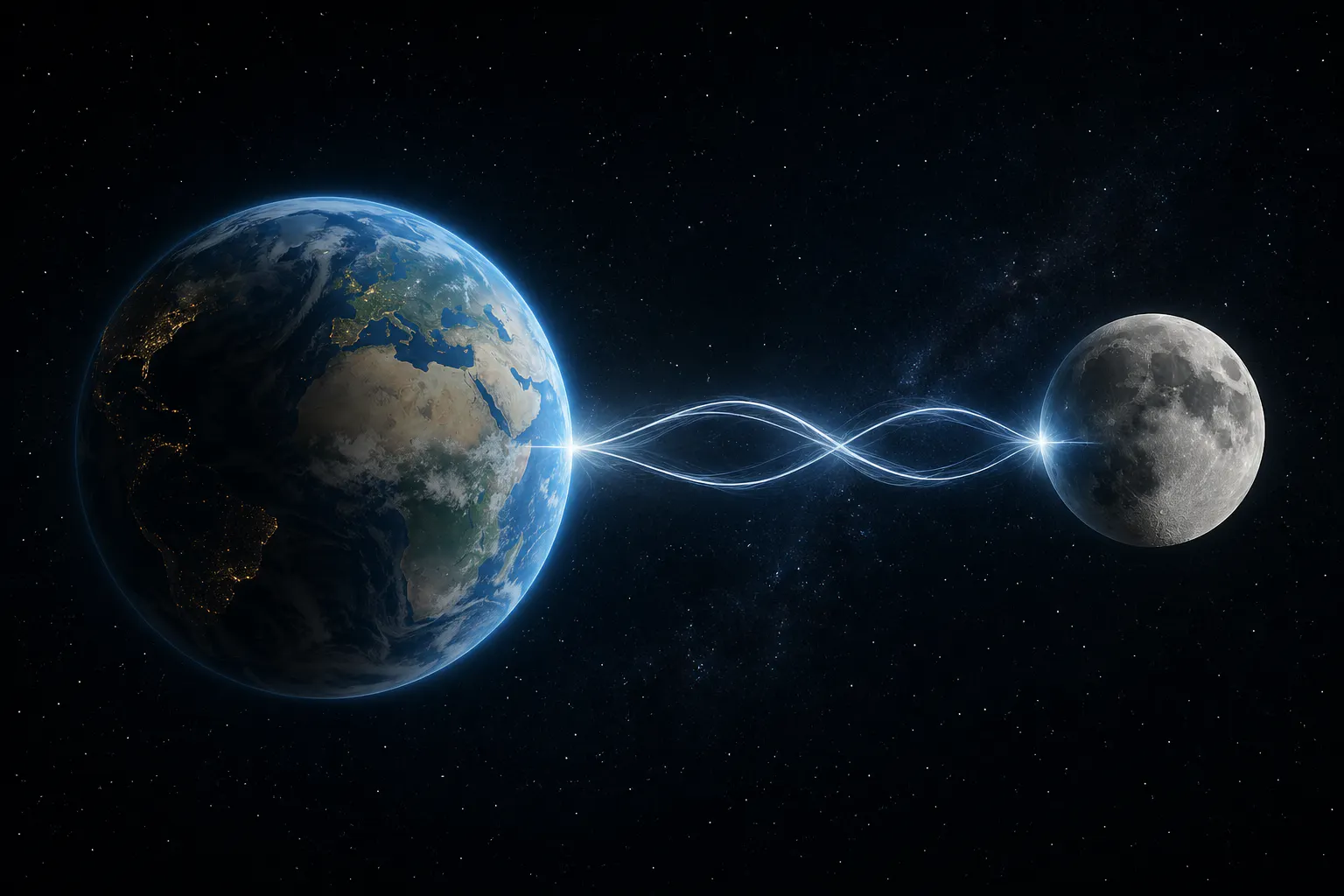
This is until relatively recently, where a new domain between the Earth and the Moon is beginning to take shape. Otherwise known as the cislunar space, this term describes the previously mysterious and expansive void between the two celestial companions. Artemis II exemplifies humanity’s gradual shift not only as explorers, but as developers of cislunar space. Over a series of international missions, we will increasingly see cislunar space become the future “corridor” for navigating, supplying and ultimately inhabiting deep space. This will be achieved through the establishment of an infrastructure and supply value chain for the space economy.
With the recent Artemis II mission,humanity has secured its first ticket back to the Moon. While the previous Apollo agenda aimed to reach the lunar body, the Artemis agenda represents a generation intent on building systems to cohabit there and hopefully remain. Through the scientific discovery, international cooperation and human and robotic missions of the pat can we envision a long-term system in space, with the aforementioned achievements representing essential layers of a broader social and economic architecture. In this model, the Moon becomes both a destination and proving ground.
At the centre of this emerging cislunar development is the Lunar Gateway, a program to design the world’s first space station for the Moon. It is scheduled for launch no earlier than 2027, operating in a near rectilinear halo orbit (that is, a highly elliptical six-and-a-half-day trajectory that will bring the station as close as 7,000 km to the lunar surface and as far as 70,000 km into deep space). In doing so, the station will be positioned to allow efficient transfers both to the Moon and back toward Earth. Essentially the gateway will act as a natural “crossroads” of movement between the two outposts.
Unlike its counterpart, the International Space Station (ISS), the gateway will not be built for continuous occupation, seeing as it is only 20 metres long (and not 50 metres as is the former). As a result, the gateway will be designed to operate largely autonomously, with astronauts living aboard for periods of up to three months. Most of the time otherwise it will function without a crew, supported by robotic systems and remote operations. Essentially, the gateway will serve as:
- A staging point for lunar surface missions
- A hub for scientific research in deep space
- A logistics node connecting Earth orbit, lunar orbit, and the surface
In doing so, the gateway will become the first fixed anchor in cislunar space.
Gateway is also a model of international and industrial collaboration, and its various components have been structured in a modular fashion and as provided by the various stakeholders as follows:
- NASA’s Power and Propulsion Element (PPE) and Habitation and Logistics Outpost (HALO) form the core
- ESA contributes Lunar I-Hab (habitation), Lunar View (refuelling and observation), and Lunar Link (communications)
- JAXA provides life-support systems
- The Canadian Space Agency contributes Canadarm3
- The UAE provides the crew and equipment airlock
This distributed architecture reflects the complexity of cislunar space, requiring multiple actors to support its integration.
However, why should we care about returning to the moon? The lunar genealogy preserves a universal record offering insights into planetary formation in addition to the Earth-Moon relationship. Its surface also provides grounds for scientific research, especially in astronomy, that are difficult to replicate elsewhere. But beyond the mere allure of science, the Moon may also one day serve a strategic function. It's close enough to access, but yet distant enough to foster operational capabilities. This makes for an ideal mission environment where lunar logistics and resilience can be prepared and tested.
As expected in the cislunar domain would be increased challenges, some of which may extend beyond engineering. As activity expands, coordination also becomes essential. These multiple operators would need to share trajectories for the most part, in addition to possible interoperability for infrastructure, hardwares (such as docking interfaces) and even communications. Most notably, any proximity operations (where vehicles maneuver near one another), must be conducted safely). It also goes without saying that logistics must also be reliable over long durations. Such challenges are considered normal for space. But they can prove more complex at greater distances from Earth. That being said, governments and industry alike are already working to help improve space situational awareness and develop norms of responsible behaviour, because history offers us a useful analogy.
New frontiers typically evolve in stages starting first with exploration (which demonstrates possibility), followed by infrastructure (which enables sustained activity). Eventually, when both of these are established an economic system can take root, supported by logistics, services and governance, amongst other aspects. We have already witnessed LEO undergo this transition so we can expect cislunar to do the same, and it is beginning to, albeit at different scales, distances and cost factors, in addition to increased coordination requirements. But as the article has maintained, the underlying logic remains fairly consistent.
As new systems, business models and missions are emerging, the cislunar space is also growing to connect and accommodate humanity’s growing aspirations towards space. The lunar gateway represents a stepping stone towards building infrastructure beyond Earth’s orbit, making the space between celestial destinations more usable. In time, that space will become more structured and perhaps indispensable to human life in space, and even here on Earth, and the decisions we make now will shape how our future space economy grows.