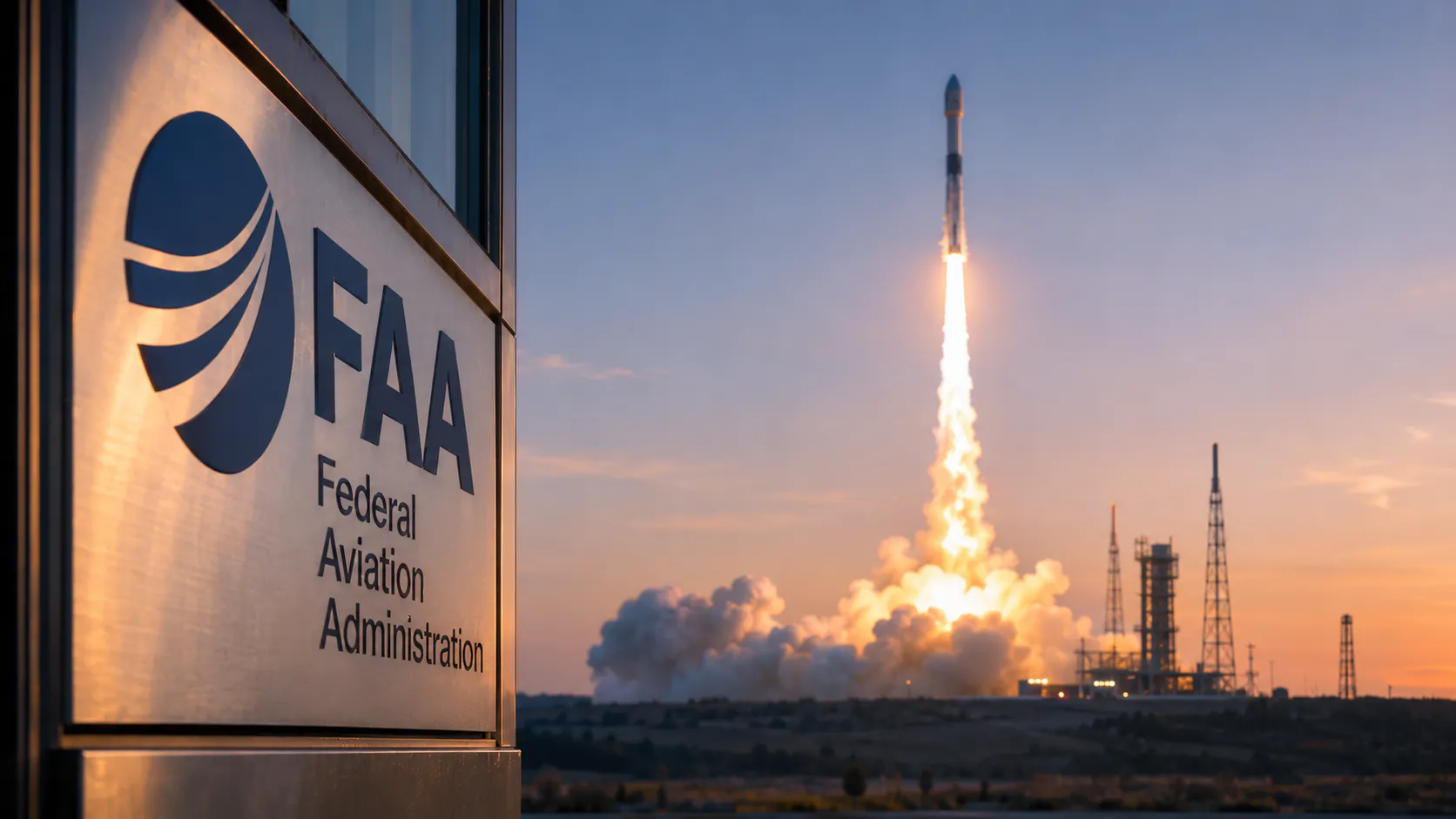
The United States wants to enable at least 1,000 commercial space launches and re-entries annually by 2030. In 2025, the country recorded 178 launches and re-entries under the figures cited by Reuters, meaning the target calls for an operating environment capable of handling several times today’s activity. The Federal Aviation Administration’s latest licensing proposals address one part of that challenge: how to process commercial launch applications without requiring operators to repeatedly demonstrate the same safety considerations through overlapping procedures. Published on 5 October 2026, the FAA’s five proposed rules would revise elements of Part 450, the framework governing commercial launch and re-entry licensing. The proposals cover electronic applications, flight safety analysis, physical containment, lightning hazard mitigation and blast-effects analysis. Public comments are due by 4 November. The changes are technical in detail, but their commercial significance is straightforward. As launch activity expands, the time and effort required to obtain regulatory approval become part of the industry’s operating environment. Reducing unnecessary duplication could help operators prepare missions more efficiently. The harder question is how to simplify the process while preserving the agency’s ability to evaluate risks to people, property and the national airspace.
Part 450 consolidated the FAA’s substantive launch and re-entry licensing regulations in 2021. The framework established a common structure for demonstrating compliance with safety requirements, including flight safety analysis. The current proposals revisit specific elements of that framework in response to the administration’s objective of increasing commercial launch activity.
One proposal would allow additional electronic methods for submitting licence applications, permits, waiver requests and related material. Another would consolidate information required for flight safety analysis, while providing more flexibility in demonstrating compliance through accepted means of meeting regulatory requirements.
These changes address the administrative work surrounding a launch, including how applicants organise evidence and how the agency assesses it. That matters to operators managing multiple vehicles, launch sites or missions. When an application relies on information already accepted elsewhere in the licensing process, a requirement to reproduce or reformat that information can consume time without necessarily producing a corresponding improvement in the safety assessment. Electronic submission may also make document handling more efficient. Neither measure guarantees a shorter approval timeline, however. Completeness of applications as part of the FAA’s review requirements will continue to affect processing. The proposals therefore target friction in the licensing process, not the underlying engineering challenges of launching a rocket. They cannot manufacture additional launch pads, accelerate booster refurbishment or resolve supply-chain constraints. Their contribution is narrower: they may reduce some of the administrative effort involved in authorising commercial activity. The more consequential proposals concern how operators demonstrate that particular hazards are controlled.
Under the proposed physical-containment change, operators using containment as a hazard-control strategy would not need to develop flight hazard areas under the same analysis requirements. The FAA also proposes a limited exception to specified lightning-mitigation requirements for certain descending flight phases, where the vehicle’s trajectory and any resulting debris are constrained to remain clear of the public and critical assets. A separate proposal would clarify that blast-effects analysis need not account for members of the public at hypothetical locations.These are targeted changes, not a general exemption from launch safety requirements. Their logic is that the method used to demonstrate compliance should reflect the actual hazard and the controls available. Physical containment, for example, may address a risk through engineering measures that make a separate hazard-area analysis unnecessary under the proposed approach. From a commercial perspective, flight safety assessments require technical evidence, modelling and documentation. If the rules allow operators to rely on an appropriate existing safety demonstration instead of duplicating work, resources can be directed towards risks that genuinely need further analysis. Yet any such gain depends on the boundaries of the final rules and the quality of the evidence operators provide. Safety requirements also protect interests beyond the launch company. A launch can affect workers, members of the public, property, air traffic and neighbouring operations. The FAA’s statutory mandate includes protecting public health and safety, property and relevant national interests. Efficiency cannot therefore be measured solely by how quickly a company receives a licence. It must also account for whether the resulting decision remains supported by a credible assessment of the operation.
The proposed reforms sit within a wider effort to expand US launch capacity. The administration’s target of 1,000 launches and re-entries per year by 2030 creates pressure across the sector in which launch providers need manufacturing capacity and reliable operations, customers need predictable access to orbit, and regulators must be able to assess a larger volume of activity. Licensing is one component of that system. A streamlined process could reduce administrative burdens, but the relationship between licensing efficiency and actual launch numbers is not automatic. Physical infrastructure, workforce availability, vehicle reliability, supply chains, range operations and airspace coordination all constrain how frequently missions can fly. This is particularly relevant for companies seeking to scale reusable launch services. Reusability can reduce the need to manufacture an entirely new launch vehicle for each mission, but its commercial value depends on turnaround time, refurbishment and operational reliability. Regulatory reform may support higher cadence, but it cannot substitute for those capabilities.
There is also a difference between a policy target and a demonstrated industrial trajectory. Moving from 178 launches and re-entries to 1,000 within five years would require a substantial expansion of activity. The proposed rules are one attempt to remove regulatory friction along that path. Their effect will depend on how they are finalised and implemented, and on whether other parts of the launch system expand at a comparable pace. The comment period ending on 4 November offers industry, technical specialists and other stakeholders an opportunity to scrutinise the proposals before the FAA decides whether and how to finalise them. The details of import include which forms of evidence can be consolidated, how equivalence in safety is demonstrated, and where specific exceptions apply will shape the practical consequences for operators. For commercial spaceflight, the important outcome is not simply a shorter application. It is a licensing framework that can process growing activity without losing the ability to distinguish between different risks and operating conditions. Resultantly, the FAA is attempting to make commercial launch regulation more adaptable to a larger market. Whether that produces meaningful gains in launch cadence will be established beyond the rulemaking process, in the operating performance of the companies and infrastructure the rules are meant to support.