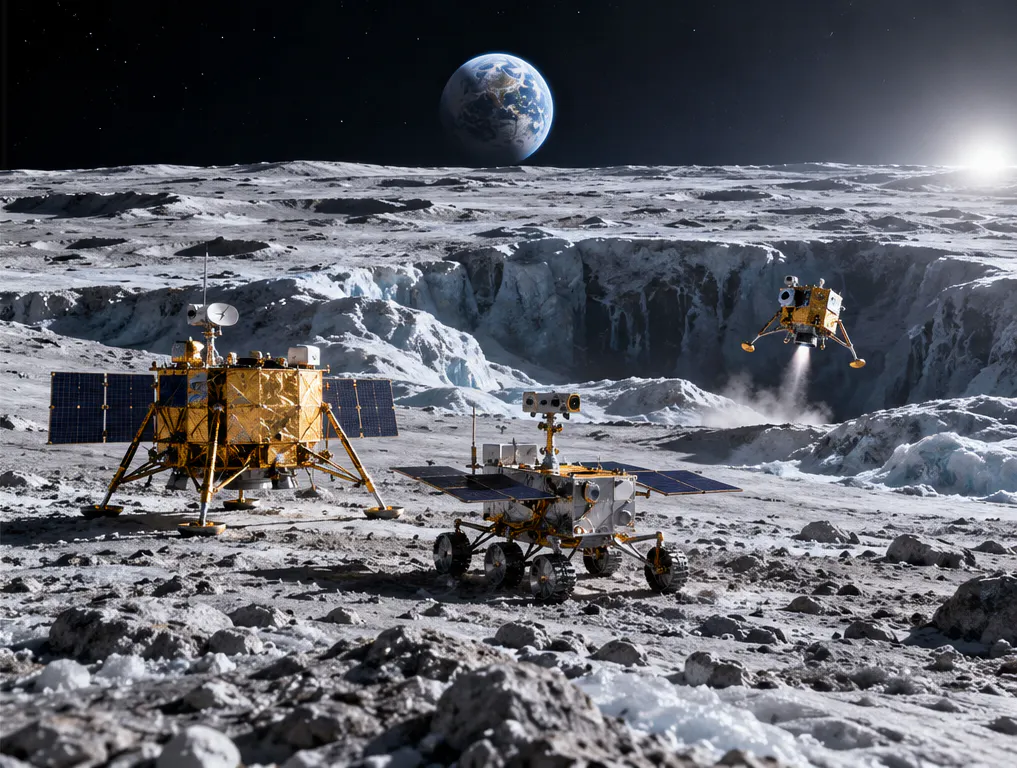
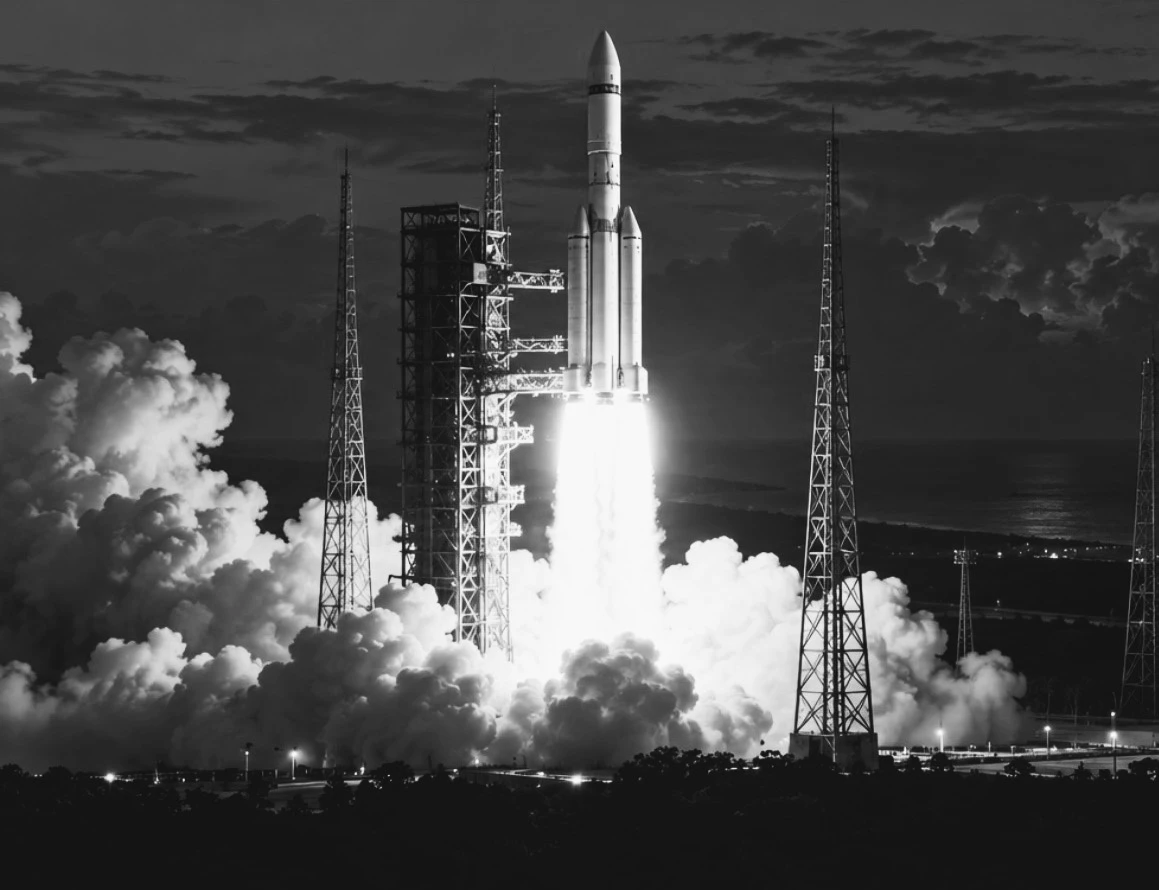
A lunar mission can spend years being designed and still depend on a matter of days. China’s Chang’e-7 was prepared for launch from Wenchang in August 2026, with a Long March 5 carrying an orbiter, lander, rover and a hopping probe intended to investigate the Moon’s south polar environment. On 23 August, China announced that the mission would not proceed within its planned 2026 window after a comprehensive assessment concluded that launch conditions had not been met.The announcement did not identify a specific technical failure, but rather, as explained by Thailand’s National Astronomical Research Institute, whose CE-7 MATCH instrument is aboard Chang’e-7, that Tropical Storm Narra had contributed to the delay and that the mission’s particular lighting requirements meant the 2026 opportunity could no longer be used. Therefore, while the public record establishes the postponement and the narrow environmental constraints, it does not however establish that the spacecraft itself suffered a technical fault. Regardless, the mission is now expected to move into a 2027 opportunity.
Chang’e-7 is unusually dependent on the lunar environment it is being sent to study. Its target is the south polar region, including permanently shadowed areas where temperatures remain extremely low and where water ice and other volatile compounds may have accumulated. The mission’s hopping spacecraft is designed to enter such difficult terrain, while the orbiter, lander and rover provide complementary observations. Its scientific objective therefore depends upon an alignment between spacecraft performance, lunar illumination and the geography of the landing region. As a result of the foregoing, the south pole is becoming a focal point for lunar exploration precisely because the environment offers both scientific value and potential resources. China’s programme describes Chang’e-7 as a mission to survey the lunar surface environment, water, ice and volatile elements, while Chang’e-8 is intended to conduct experiments involving the utilisation of lunar resources. Together, the missions form part of China’s planned International Lunar Research Station, whose basic model is targeted for completion by 2035. The infrastructure being assembled around Chang’e-7 is also international. Six scientific instruments on the mission were developed through cooperation involving Egypt, Bahrain, Italy, Russia, Switzerland, Thailand and the International Lunar Observatory Association. The payloads range from lunar surface imaging and laser retroreflectors to space-weather monitoring and measurements of radiation affecting Earth’s climate system.Thailand’s experience with the postponement consequently illustrates how a nationally led mission moves, and how its accompanying partners carrying scientific hardware, teams and research objectives move with it.
As alluded to in the foregoing paragraph, such missions are the result of international cooperation as one of the foundational principles of outer space affairs, so it goes without saying then that China is not building its lunar programme solely through Chinese hardware. CNSA has described the International Lunar Research Station as a facility involving lunar surface and orbital elements, with planned capabilities including energy supply, communications, navigation, lunar-surface exploration and Earth-Moon transportation. By 2025, China reported that 17 countries and international organisations and more than 50 research institutions had joined the initiative. The architecture is therefore developing through a combination of national missions and international contributions, with Chang’e-7 and Chang’e-8 positioned as early components of a longer-lived system, which development is taking place alongside another emerging framework for lunar activity.
The United States and its partners have built the Artemis Accords around principles derived from the Outer Space Treaty, including peaceful exploration, registration, interoperability, emergency assistance and the release of scientific data. By September 2026, 76 countries had signed the Accords.China’s ILRS and the Artemis framework are not legally identical instruments, nor do they represent competing versions of a single international regime. They do, however, demonstrate that lunar exploration is moving towards arrangements in which access to critical infrastructure to enable scientific advancement and cooperation will have to be organised across multiple national and institutional frameworks. Starting at the international level, the underlying treaty position remains significant. Article I of the Outer Space Treaty establishes freedom of exploration and use, while Article II prohibits national appropriation of the Moon and other celestial bodies. The Treaty also requires States to facilitate international cooperation in scientific investigation. These principles provide the legal foundation within which the emerging lunar programmes are being developed, while leaving substantial questions about how sustained operations, resource use, infrastructure and interactions between different lunar actors will be managed.
Chang’e-7’s postponement therefore arrives at an interesting stage in lunar exploration. The mission has not been abandoned, and the available evidence does not support treating the delay as a failure of China’s lunar programme. A carefully selected launch window is part of the engineering problem when the objective is to operate at the Moon’s most demanding terrain. What the delay does reveal is the degree to which future lunar capability will depend upon synchronising launch systems, spacecraft, environmental conditions, international payloads and the infrastructure that follows a successful landing.