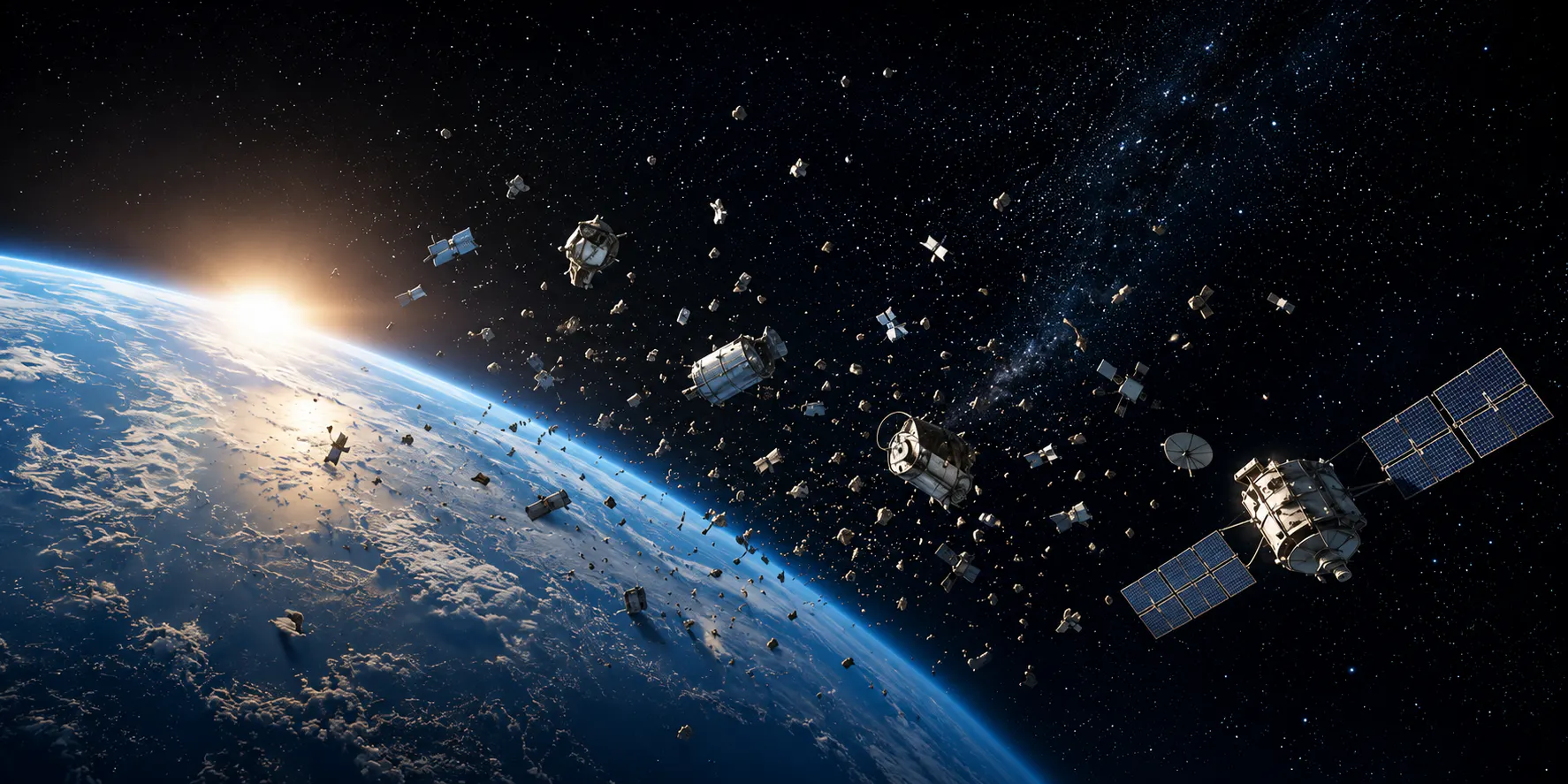
For most of human history space has represented both distance and mystery, and more recently, possibility. And as a result of its permanence and critical nature, it is increasingly resembling a form of infrastructure necessary for daily life. This is because satellites help guide navigation, they support financial systems, they also enable telecommunications and monitor climate conditions, in addition to underpinning vital military, civilian and other security architectures. Yet, as reliance on orbital systems grows, so does the pressure on the surrounding space environment. Once empty, space is now a congested and contested frontier, making it ever the more fragile.
During the Artemis II mission, the reality of the above environmental conundrum was placed on center stage. Before the crew could even escape Earth’s gravitational pull to enter into lunar trajectory, the Orion spacecraft needed to bypass various layers of orbital traffic, already crowded not only by satellites, but also fragments of space objects and inactive hardware alike. This journey highlighted the uncomfortable truth that humanity’s expansion into space is dependent on an environment that is becoming more difficult to manage as the number of stakeholders, and their respective missions, grows.
According to recent estimates made by the United Nations (UN), there are more than 130 million pieces of debris currently orbiting Earth, ranging from abandoned spacecraft to millimetre-sized fragments created by explosions and collisions.While a fraction of these are actively being tracked, even the smallest of debris can still prove immensely destructure at the high velocity at which they travel. In fact, NASA opines that some of these fragments travel at speeds of up to approximately 15 kilometres per second, which is nearly ten times faster than the speed of a bullet.
And while space is commonly known as a vacuum, this does not mean that objects remain static. As mentioned already, space objects occupy various positions along the so-called orbital highway. These slots are valuable for everyday use-cases in communications, weather forecasting, navigation and Earth Observation to name a few. Low-Earth Orbit (LEO), the band of space approximately 500 to 600 kilometres in altitude, has become one of the most densely populated regions of space with more than 4000 active satellites now operational. These satellites are managed by hundreds of commercial, governmental and research entities across dozens of countries.
The crowding of space has the unfortunate consequence of raising collision risks, and when spacecraft collide, they have the potential to generate thousands if not millions of additional fragments, further increasing the likelihood of future impacts. This danger is cumulative, as was evident in 2009, when a collision occurred between a functioning American satellite and a defunct Russian military spacecraft. This produced extensive debris fields which are still being tracked today. Such events raise concerns about a cascading process known as the Kessler Syndrome, where collisions generate more debris, which in turn causes further collisions. In its most severe form, certain orbits could become temporarily unusable.
Aside from the technical and operational risks, there are also economic factors to consider. The OECD estimates that approximately USD 191 billion worth of orbital economic activity is exposed to debris-related risks. Of the myriad types of satellites in use, weather satellites, disaster monitoring systems and scientific spacecraft occupy some of the highest-risk corridors. Crucially, nearly all of this exposure stems not from active spacecraft, but from defunct objects and abandoned rocket bodies left behind from earlier missions.
Space sustainability therefore refers to the long-term use of outer space in ways that preserve orbital environments for future generations, while maintaining safe, reliable access to space infrastructure. It includes aspects such as:
● Debris mitigation
● Responsible satellite disposal
● Reduced environmental impact during launch and re-entry.

This issue is increasingly urgent as over 9500 active satellites float above Earth’s surface.Environmental considerations are thus at the forefront of space sustainability discussions. With every launch, soot, aluminum particles and chemical compounds are ejected into the upper atmosphere. These emissions may alter atmospheric chemistry and contribute negatively to ozone depletion. Reentering spacecraft also leave behind metallic residues and oxides which can affect how sunlight interacts with the atmosphere. While research remains ongoing, early findings suggest that space activity may also intersect with broader environmental systems even on Earth.
What results is a governance challenge. Existing legal frameworks such as the 1967 Outer Space Treaty established broad principles around peaceful use and harmful contamination, but they were designed for a much smaller space economy. In today’s parlance, the regulatory environment is fragmented, and bodies such as the UN Committee on the Peaceful Uses of Outer Space (UNCOPUOS), the International Telecommunications Union (ITU) and national licensing authorities each govern different components, with no unified environmental framework for space. And pursuant to that, compliance remains uneven. Orbit-clearance recommendations suggest satellites should be removed within a defined period after mission completion. Yet OECD assessments indicate that only 55% of satellites complied with disposal guidance in 2022. While voluntary standards exist, they often lack enforcement mechanisms.
This has shifted attention towards policy innovation, where several approaches are now emerging. For instance, command-and-control regulations could help impose mandatory disposal rules. Incentive-based systems (like orbital taxes, refundable compliance bonds or sustainability-linked licensing) may also spur responsible behaviour while preserving market flexibility. Lastly, voluntary rating systems could also shape investor and insurer preferences by rewarding operators that demonstrate sustainable orbital practices.
Most importantly, evidence from environmental economics suggests that regulation may not necessarily hinder growth. Research conducted by the OECD indicates that environmental standards often stimulate innovation by encouraging industries to develop cleaner and more efficient technologies. In the space sector, this may accelerate developments in autonomous collision avoidance, active debris removal, reusable spacecraft components and cleaner propulsions systems, to name a few.
Space sustainability is a foundational requirement for the longevity of the future space economy. It has been discussed severally that Earth’s orbital environment resembles critical infrastructure, and while invisible, it remains ever indispensable. Like oceans, airspace and even digital networks, it requires responsible innovation and stewardship. The choices made today regarding debris mitigation, environmental standards and orbital governance will help determine whether space remains usable in the decades to come. If the 20th century was denied by access to space, then the 21st century will be defined by how we preserve it for the generations to come.