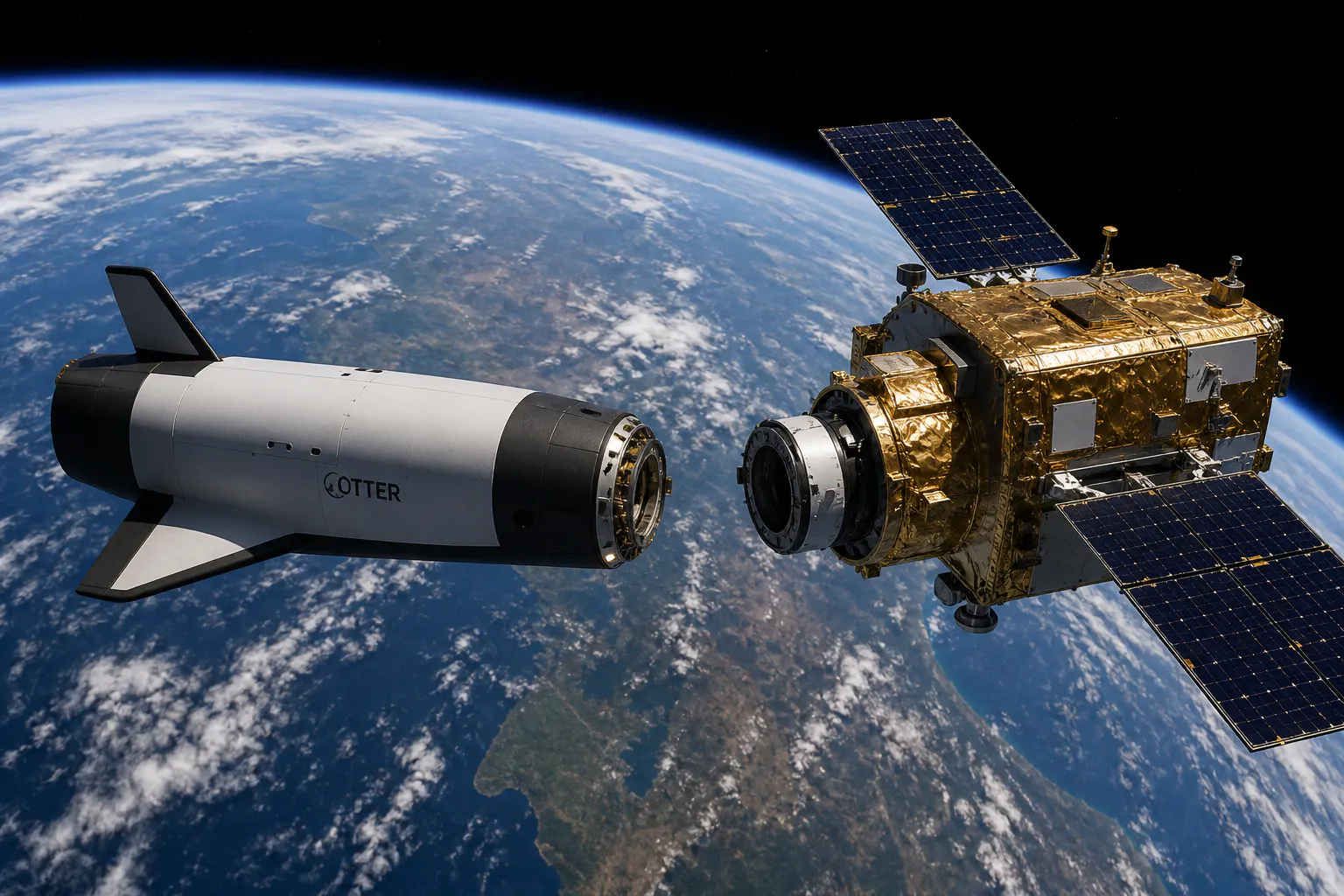
The space economy has long been organised around the simple assumption that satellites are operated up until such time as they can expire and be left in orbit. However, in order for infrastructure to persist in space requires maintenance, which previously consisted of ground-based controls or high-cost interventions. On-Orbit Servicing (OOS) was hardly an active service domain, however this model is beginning to take shape.A new class of capability is emerging that treats orbits as an operating system, and this shift is most visible in the rise of on-orbit servicing vehicles such as Starfish Space’s Otter, designed for satellite life-extension, space debris removal as well as autonomous docking operations.
Space activity has been dominated by launch capability and satellite manufacturing since our first forays into orbit, following the linear development path of build, launch, operate, replace, and repeat. In this framework, satellites and other space objects were considered capital assets with fixed depreciation curves and limited operational flexibility. Vehicles such as Otter disrupt the space economy by introducing a second order layer, namely the opportunity to delay depreciation through servicing and maintenance. This is known as post-deployment value creation.
Instead of ending the space objects operational life at fuel depletion or subsystem failure or other factor, satellites can now be:
- Refuelled or repositioned
- Extended in operational life
- Safely deorbited or relocated
- Inspected and diagnosed in orbit
In so doing, satellites become persistent infrastructure nodes in space, and value continuously maintained beyond launch. Starfish Space, founded in 2019, is among the early companies operationalising this model. Its Otter platform is designed for both cooperative and non-cooperative interactions and autonomous operations.
Most notably in current developments, and commercially significant, was Starfish’s agreement with Intelsat, the latter being one of the world’s largest satellite operators.
From 2026 onwards, the Otter vehicle is expected to:
- Dock with a retired intelsat satellite in geostationary graveyard orbit
- Transition to an operational spacecraft
- Provide life-extension propulsion services to maintain orbital position
This development marks an important milestone in geostationary orbit economics. GEO satellites are referred to as high-value infrastructure for the uses in telecommunications, broadcasting, and other data-relay systems where replacement costs are substantial and downtime is expensive.
Life extension services ameliorate the financial risks:
- Capital expenditure is deferred
- Asset lifetime is extended
- Revenue generation per spacecraft increases
In effect, orbital servicing becomes a subscription layer for satellite continuity, analogous to industrial maintenance contracts in terrestrial infrastructure systems.
Commercial GEO servicing is but one part of the emerging market. Hot on its heels, government demand is accelerating the Low Earth Orbit (LEO) servicing segment, especially around debris mitigation and constellation management. In this regard, Starfish has secured multiple public-sector contracts, including:
- A $52.5 million space Development Agency (SDA) mission to deorbit satellites in the Proliferated Warfighter Space Architecture (PWSA)
- U.S. Space Force contracts for docking and orbital maneuver demonstrations
- NASA inspection missions for non-functional spacecraft
These missions all reflect a growing institutional requirement for orbital sustainability as a managed service layer. The more LEO becomes congested, the greater servicing and enforcement mechanisms will be necessary to maintain order in orbit.
When viewed across orbital layers, then the significance of OOS becomes even more apparent.
- GEO asset extension layer
● High value satellites require life extension and orbital repositioning. Servicing here is used as a tool to maximise Return on Investment (ROI).
- LEO constellation maintenance layer
● Here the focus shifts to: Debris removal; End-of-Life (EOL) disposal, and; Fleet management
- Transitional Operations: Cross orbit servicing
In future, systems are likely to operate across multiple of these domains, enabling a form of orbital logistics mobility, where servicing vehicles function as infrastructure tugs between orbital zones, thereby creating a new category of s[ace capability known as orbital persistence maintenance.
Despite strategic promise, OOS is constrained by four main structural factors:
- Physical constraints
● Limited cocking windows coupled with the requirement for extreme precisions restricts the number of missions per vehicle.
- Industrial constraints
● OOS systems usually require high-certification manufacturing cycles and tightly integrated hardware-software stacks.
- Regulatory constraints
● Liability and sovereignty are regulatory lacunae considering that space is multi-jurisdicitional, public good
- Economic constraints
● Servicing only scales if orbital density and satellite value justify intervention costs. For this reason, under utilisation risks turning servicing assets into stranded capital.
There are three main takeaways to note from the foregoing discussion.
Firstly, satellites are notably becoming managed nodes within a continuous operational environment, as opposed to fully autonomous assets. Secondly, value creation is slowly shifting from launch capability to lifecycle optimisation. And thirdly, and resultantly, orbital governance is no longer theoretical. This case study has ultimately demonstrated that servicing systems are introducing the early foundations of an orbital logistics economy, where maintenance, refuelling, debris removal and asset repositioning all become standardised services as opposed to bespoke missions.
OOS will not replace existing systems if launch and satellite design by a long shot, however, it overlays them with a persistent layer of maintenance and optimisation. Think of it like a car servicing cycle, and the implication would thus be subtle though significant. Orbit is becoming an environment requiring staged management. Starfish Space’s Otter programme therefore illustrates this shift clearly, where satellites have evolved beyond mere endpoints of engineering cycles. In the ongoing, dynamic system of orbital management, the defining feature of space infrastructure will be continuity.