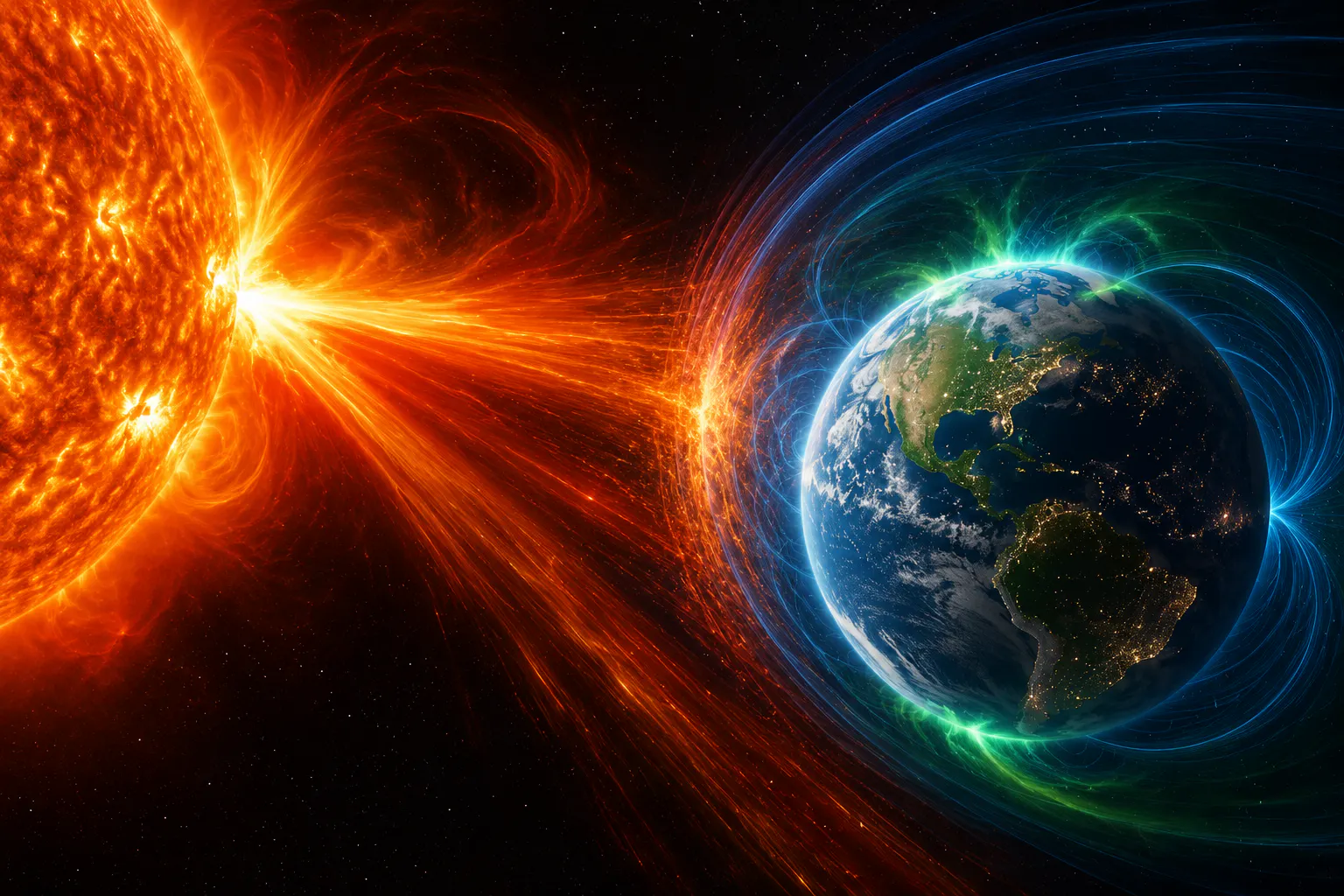
When one hears the terminology “space infrastructure” images of engineering structures, global geopolitics and even economics may come to mind. Increasingly however, space terms of references are expanding to include additional forces and factors that have a bearing on our access to space. For instance, another force re-entering the conversation is the Sun itself. As satellite constellations expand and societies become more dependent on orbital systems, space weather emerges as one of the most consequential (albeit least understood) risks to the modern space economy.
As opposed to its terrestrial counterpart, which is composed of various weather elements and events, space weather refers to disturbances generated specifically by solar activity including solar flares, coronal mass ejections (CMEs) and geomagnetic storms. Such events release massive quantities of charged particles and electromagnetic radiation into space. When these forces are directed towards earth, they interact with the planet's magnetic field and upper atmosphere, disrupting both space-based and ground-based infrastructure. Historically, these events were scientific curiosities. Today, they represent infrastructure risks with potential to cause widespread damage.
Today’s global economy depends heavily on satellites for navigation, communications, financial synchronisation, weather forecasting and defence organizations. More than 9,500 active satellites are currently orbiting earth, concentrated particularly in the band of space known as Low-Earth orbit (LEO). Many of these satellites operate within crowded orbital corridors already feeling the strain of debris and collision risks. Space weather compounds this risk by adding an additional layer of vulnerability to this environment.
The effects of space weather can be felt almost immediately. Solar storms can interfere with Global Navigation Satellite Systems (GNSS) such as GPS and Galileo, degrading positioning accuracy or otherwise interrupting critical signals entirely. This matters because timing signals from satellites underpin far more than just navigation. Telecommunications networks, banking systems, stock exchanges and energy grids equally rely on precise synchronization derived from space-based timing infrastructure. In some severe cases, geomagnetic storms can physically damage satellites. Charged particles may disrupt onboard electronics, interfere with communications payloads or degrade solar panels over time. During periods of heightened solar activity, Erath’s upper atmosphere also expands, increasing atmospheric drag on satellites in LEO. This causes spacecraft to lose altitude more rapidly than expected.
In 2022, SpaceX lost dozens of newly launched Starlink satellites after a geomagnetic storm increased atmospheric drag before the satellite could properly raise their orbits.The incident illustrated how even advanced commercial operators remain vulnerable to solar conditions.

The timing is significant because the sun is now approaching the peak of Solar Cycle 25, an approximately 11 year cycle of solar activity expected to intensify through 2025 and 2026. Scientists anticipate increased frequencies of solar flares and geomagnetic disturbances during this period.As orbital dependence grows simultaneously, exposure is increasing precisely as solar activity accelerates. This challenge extends beyond satellites themselves. Modern launch systems, aviation routes, and even terrestrial energy grids are also exposed to severe space weather. High-frequency radio communications used in aviation and maritime sectors can become unreliable during solar events. Power transmission systems on Earth may experience geomagnetically induced currents capable of damaging both transformers and grid infrastructure.
The 1859 Carrington Event remains the benchmark scenario. Widely considered the most powerful recorded geomagnetic storm, it disrupted telegraph systems globally and generated auroras visible near the equator.If a comparable event occurred today, analysts estimate that economic damage could extend into trillions of dollars due to disruptions in interconnected digital infrastructures. This has shifted space weather from a scientific niche into a strategic policy issue, requiring governments and space agencies to collaborate in treating solar monitoring as a matter of national resilience. Agencies such as NASA, National Oceanic and Atmospheric Administration, and the European Space Agency now maintain continuous solar observation programmes to monitor and forecast solar activity.
Yet forecasting space weather remains difficult. Unlike terrestrial weather systems, solar phenomena involve highly dynamic plasma interactions that are harder to predict precisely. While warning times have improved, operators may still have limited windows to reposition satellites or prepare other infrastructure for disturbances. And commercialisation complicates this further. The rapidly growing mega-constellation arena means thousands of satellites are now being deployed on compressed timelines. These systems often prioritize scalability and rapid deployment, but large constellations also create larger aggregate exposure to solar conditions. A single server event could affect multiple operators simultaneously.
The challenge increasingly resembles climate resilience, but in orbit. The issue is not will but rather when it will occur, and the solution is to build orbital systems that are designed to absorb and recover from these risks in orbit. Importantly, this discussion also intersects with broader debates around space sustainability. A solar storm in an already crowded orbit raises the risks of collisions and debris. Which reinforces the broader reality emerging across the space sector, where space is considered critical global infrastructure. As our ambitions grow into the cosmos, future lunar and cislunar architectures will operate with even greater exposure to radiation and solar activity. Space weather resilience will therefore become a matter as important for human activity as commerce and even development.
For much of the space age orbital infrastructure was designed around engineering constraints and geopolitical competition. We are seeing, however, a more concerted effort to consider the environmental realities beyond Earth itself. Space weather reveals how interconnected modern civilisation has become with orbital systems that remain vulnerable to forces originating 150 million kilometres away. The Sun, once treated as a distant backdrop to human activity, is re-emerging as an active strategic variable. As the space economy expands, resilience will matter as much as access. In that sense, the future of space infrastructure may depend not only on how humanity reaches orbit, but on how well it learns to operate within a far more dynamic cosmic environment.