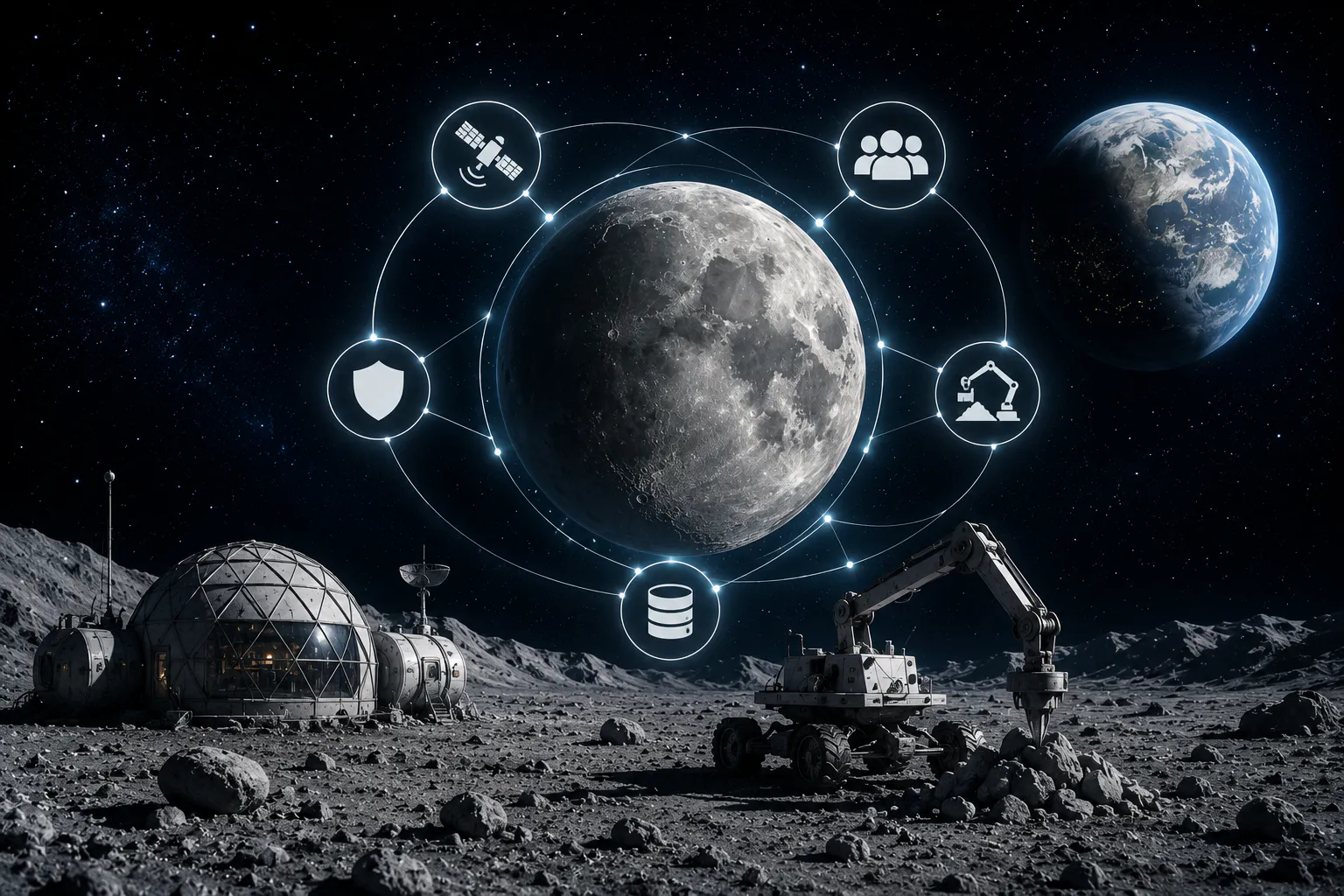
Now that humanity has conquered the Moon, how can we coordinate current and future missions to ensure that the benefits derived from outer space reach all? Missions are not only symbolic achievements, they help us gather information about the Moon, and our history in the cosmos. But who really controls that information, and under what circumstances is it shared? As states and private actors accelerate plans for lunar infrastructure, resource extraction and long-duration operations, data itself is an asset within the developing cislunar economy.
This is most evident in the dub-domain of lunar resource extraction. Though not yet fully quantified, the Moon houses deposits of minerals and elements that could fuel the future of mission activity in space, and this promise is what underpins mission planning and where actors decide to land and execute future extraction strategies. Yet while states often compete technologically, lunar exploration simultaneously depends on unusually high levels of scientific cooperation. The result is a growing tension between maintaining strategic advantage as well as promoting collective benefit-sharing.
Data sharing as a governance principle
In academic and policy literature, data sharing generally refers to the exchange of information between actors in ways that support the foundational principles of the outer space treaty. Though these principles are not expressly stated, their nuance can be gleaned from an interpretation of the various instruments. Such principles include but are not limited to:
- Transparency
- Scientific collaboration
- Operational efficiency
- Collective problem solving
When referring to the kind of data that may be derived or shared this ranges from telemetry, orbital positioning data, remote sensing information, scientific findings and mission coordination data.
Lunar exploration presents an important opportunity to amplify the foundational principles due to that react that such missions operate within constrained and high-risk environments, and as such, the exchange of vital information can be the thin line between a mission success or failure. The harsh conditions of outer space be it radiation or terrain hazards all create incentives for shared knowledge systems, and no single actor will possess a complete information coverage of the lunar environment.
This reality is reflected even in international space law. Although the Outer Space Treaty does not explicitly use the phrase “data sharing”, several of its provisions establish principles closely aligned with information cooperation, which is an extension of benefit-sharing. Article 1 specifically states that the exploration and use of outer space “shall be carried out for the benefit and in the interests of all countries”.Article 11 further encourages states to inform the United Nations (UN) Secretary-General, the public and the international scientific community about the nature, conduct and results of space activities “to the greatest extent feasible and practicable”.
Read together, these provisions create an implicit expectation that knowledge generated through space activities should contribute to the broader international scientific advancement.
Lunar missions and the strategic value of information
Reaching the Moon is not easy, hence the lunar data derived when such a feat is accomplished becomes even more valuable, as only a small group of States are capable of reaching the Moon. Since the Soviet Luna missions of the 1950s and 1960s, only a limited number of countries have successfully conducted lunar landings or orbital missions. The Soviet Union became the first country to successfully soft land on the Moon with Luna 9 in 1966. The United States (US) soon followed with the Apollo programme, which culminated in Apollo 11’s crewed landing in 1969. China’s lunar programme also accelerated substantially during the 21st century, including the Chang’e 4 far-side landing in 2019 and Chang’e 5 sample return mission in 2020. Likewise India was also able to successfully launch and land the Chandrayaan-3 near the lunar south pole in August 2023, becoming only the fourth country to achieve a soft lunar landing. Finally, Japan’s SLIM mission followed in January of 2024, demonstrating precision landing capability despite some technical complications.
States are not the only stakeholders that have endeavoured towards the Moon, as commercial participation is also expanding rapidly. Companies such as Intuitive Machines and Astrobotic are delivering lunar delivery systems under NASA’s Commercial Lunar Payload Services programme, while international partnerships are linking public agencies with private infrastructure providers. But whether through state or private sector initiative, each of these missions generates large volumes of scientific data including topographic mapping, thermal measurements, regolith analysis and resource prospecting information, all of which is beneficial to understanding the Moon and fostering economic and scientific development. For instance, water ice mapping near the permanently shadowed craters of the Moon will have a direct impact on future habitation and propellant production strategies.
From data sharing to interoperability
A core concept in the discussion of data sharing is interoperability. In technical literature interoperability refers to the ability of different systems, organisations or technologies to operate together effectively through shared standards, including sharing technology, interfaces and even procedures. Within lunar operations, interoperability may include docking compatibility for example.
Data sharing thus forms a foundational layer of interoperability because coordinated operations require common informational architectures, as safe and sustainable lunar traffic management will depend on reliable exchanges of operational data between actors. Most importantly, interoperability also reinforces broader obligations of international cooperation, as reflected throughout the Outer Space Treaty framework. Article 9 specifically requires states to conduct activities with “due regard” to the interests of other states and to avoid harmful interference. This cannot be achieved without some degree of shared situational awareness and technical coordination.
These issues and more are explored by organizations such as the Open Lunar Foundation, which focuses on governance and cooperative frameworks for lunar activity. The Open Lunar Foundation has supported discussion around open standards, shared scientific access and stewardship models designed to preserve long-term sustainability within the lunar environment.
Lunar sustainability will require a fair amount of information exchange between the diverse actors operating far beyond Earth. As discussed above, data-sharing sits at the centre of this transition because lunar operations require coordination under conditions of immense risk. This, coupled with the distance and limited infrastructure, necessitates coordination at a higher level. The principles embedded within the Outer Space Treaty anticipated elements of this challenge decades ago, even before sustained lunar operations became technologically realistic. As the Moon develops into an operational environment, the governance of information may become one of the defining questions shaping the next phase of human activity beyond Earth orbit.