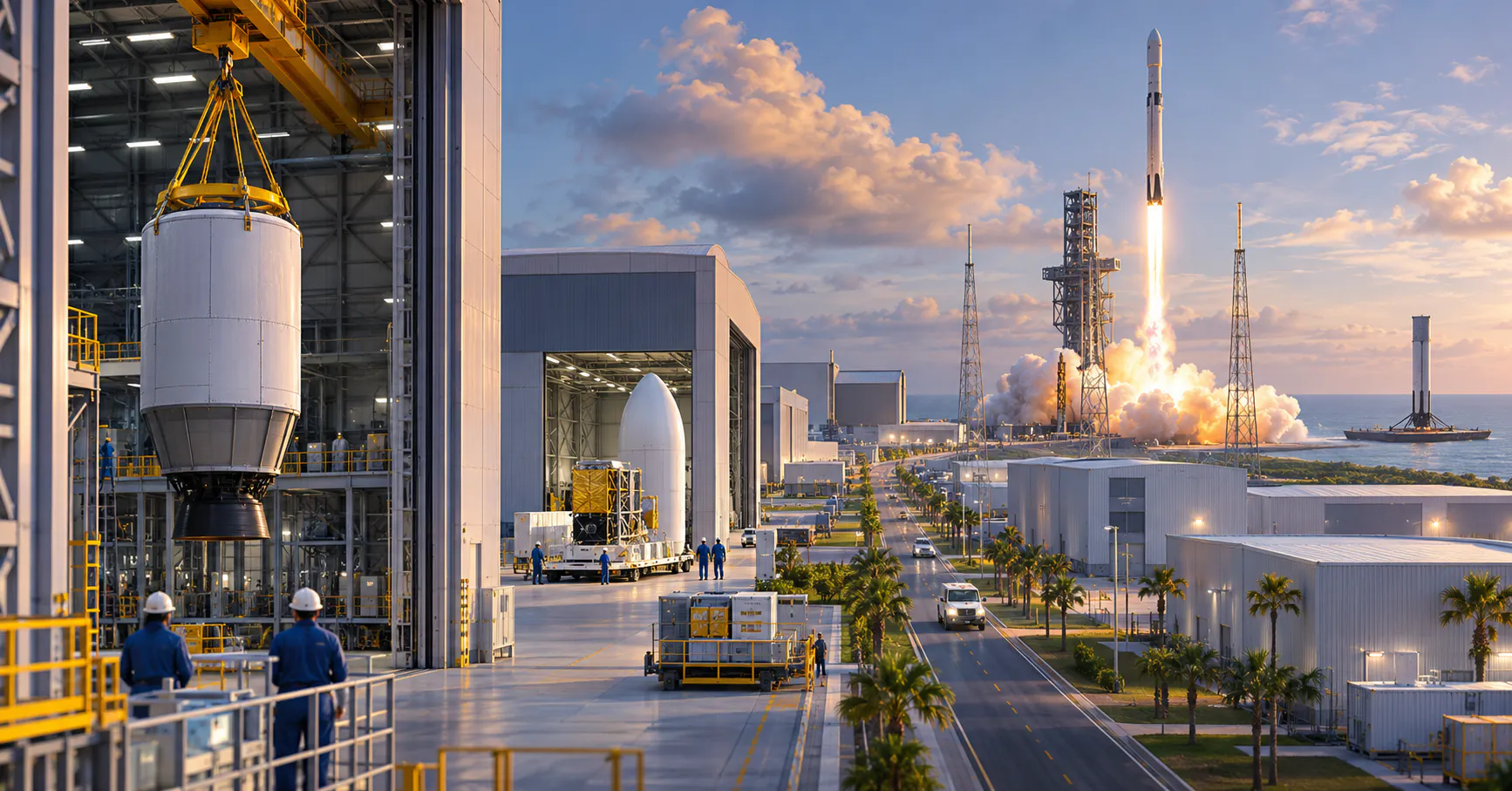
Blue Origin is investing US$330 million in a new manufacturing facility in Florida that will support annual production of up to 150 New Glenn upper stages when it opens in summer 2027. The expansion is part of a much larger industrial programme whereby the company reports more than US$3 billion invested across Florida facilities and infrastructure, with a workforce of over 5,000 employees and a network of 500 suppliers in the state. The numbers point to an ambition that extends beyond producing a larger rocket fleet. Blue Origin wants to increase the frequency with which it can manufacture, prepare, launch, recover and reuse its vehicles. That is a more demanding industrial problem than developing a launch vehicle capable of reaching orbit. It requires the entire operation to function at a pace that customers can plan around and the business can sustain.The new facility will manufacture upper stages for New Glenn’s planned 9×4 configuration.
The distinction matters, as producing up to 150 upper stages annually is a manufacturing target, not a forecast of 150 launches. Each mission also depends on the availability of the enabling infrastructure, such as rocket first stages, engines, payloads, integration facilities, launch infrastructure and the personnel needed to bring them together. Blue Origin’s own infrastructure plans have factored in this interdependence. Its programme includes a vertical integration facility, a customer payload processing complex being developed with the US Space Force, additional launch infrastructure and two further landing platforms for recovering reusable boosters. The payload complex is designed to accommodate several missions in parallel, reducing the extent to which one customer’s preparation must wait for another mission to clear the facility.
This is where the commercial significance of the investment becomes clearer. A manufacturer can expand production without achieving a corresponding increase in completed missions if its integration facilities or launch operations remain bottlenecks. Conversely, additional processing capacity has limited value if vehicles are not available when customers need them. Blue Origin is investing across these interfaces because launch cadence depends on how effectively they work together. The company says its Florida infrastructure is intended to support multiple New Glenn flights per week by the end of the decade. That is a forward-looking operational ambition, not demonstrated performance. New Glenn has flown twice, with its April 2026 mission failing to place an AST SpaceMobile satellite into its intended orbit; an anomaly in May also caused extensive damage to its launch complex. The programme therefore has to demonstrate reliable operations while rebuilding and expanding the infrastructure on which future flights will depend.
New Glenn’s reusable first stage is designed to land on a sea-based platform and return for refurbishment. Reuse can reduce the need to manufacture a new booster for every mission, but the economic benefit depends on how quickly and reliably the recovered hardware can return to service. That requires a ground operation capable of receiving a booster, inspecting it, identifying any components that need repair or replacement, and preparing it for another flight. Blue Origin is developing a dedicated facility for booster processing and refurbishment, alongside additional landing platforms intended to expand recovery capacity. More landing capacity however does not automatically translate into more launches; neither does a successful landing establish that a booster can be turned around quickly. The relevant commercial measure is the number of missions the complete system can support reliably over time, taking account of refurbishment requirements, operational delays and the cost of maintaining flight readiness. For customers purchasing launch services, that distinction affects scheduling and mission assurance. For satellite operators planning large constellations, delays can have consequences beyond the launch provider itself. Reuters reported in October that disruption to New Glenn’s programme had affected Amazon’s Leo satellite deployment schedule, illustrating how launch-provider performance can influence the plans of downstream customers. Blue Origin’s expansion is therefore partly an attempt to make launch capacity more dependable. Its success will depend on whether the company can convert additional manufacturing and recovery infrastructure into a consistent operational rhythm.
The Federal Aviation Administration is considering a separate change that would increase the maximum authorised New Glenn launch cadence at Launch Complex 36A from 12 to 50 launches annually. The proposal is subject to environmental review, with the draft assessment covering launch operations and associated activities, including engine testing, booster landings at sea and payload fairing recovery. The proposed increase is significant, but its status needs to be understood precisely. The FAA has not yet authorised 50 launches a year at the site. The agency’s draft assessment was published for public comment, with the comment period scheduled to close on 30 October 2026. The decision will follow the regulatory process, not the company’s production timetable. Nor does the proposal establish that Blue Origin can already sustain that rate. The existing licence sets a regulatory limit; the company’s manufacturing plans describe potential production capacity; its multiple-flights-per-week ambition describes a longer-term operational objective. These are related measures, but they are not interchangeable.
The proposal also concerns Launch Complex 36A. Blue Origin is developing a second complex, LC-36B, for the upgraded New Glenn 9×4 vehicle, and has outlined plans for further launch pads. The capacity of the wider system will consequently depend on infrastructure beyond the single site covered by the FAA proposal. Environmental review is part of that expansion, not an administrative footnote. Higher launch rates bring more frequent engine testing, launch operations, recovery activity and associated airspace requirements. The FAA must evaluate the proposed operating change under the applicable environmental framework before modifying the licence. The resulting decision will establish the conditions under which the proposed increase can proceed. Blue Origin’s plans illustrate the difference between possessing a powerful rocket and operating a high-cadence launch service. Manufacturing facilities, payload integration,launch pads, booster recovery and regulatory permissions all contribute to the number of missions a provider can deliver. Investment in one component cannot substitute indefinitely for constraints elsewhere.
Conclusively, the scale of Blue Origin’s Florida programme is substantial, but the more revealing milestone will be operational. Can the company return New Glenn to flight, demonstrate reliable mission execution, refurbish its boosters and increase launch frequency without creating new bottlenecks across its supply chain and ground infrastructure? The answer will shape more than Blue Origin’s own commercial prospects. As governments and satellite operators compete for access to orbit, dependable launch capacity becomes an input into national programmes, commercial constellation deployment and time-sensitive scientific missions. Blue Origin is building the infrastructure to compete at that level. Whether the investment produces the intended advantage will be measured not by the number of upper stages its factories can make, but by the missions the complete system can deliver, repeatedly and reliably.