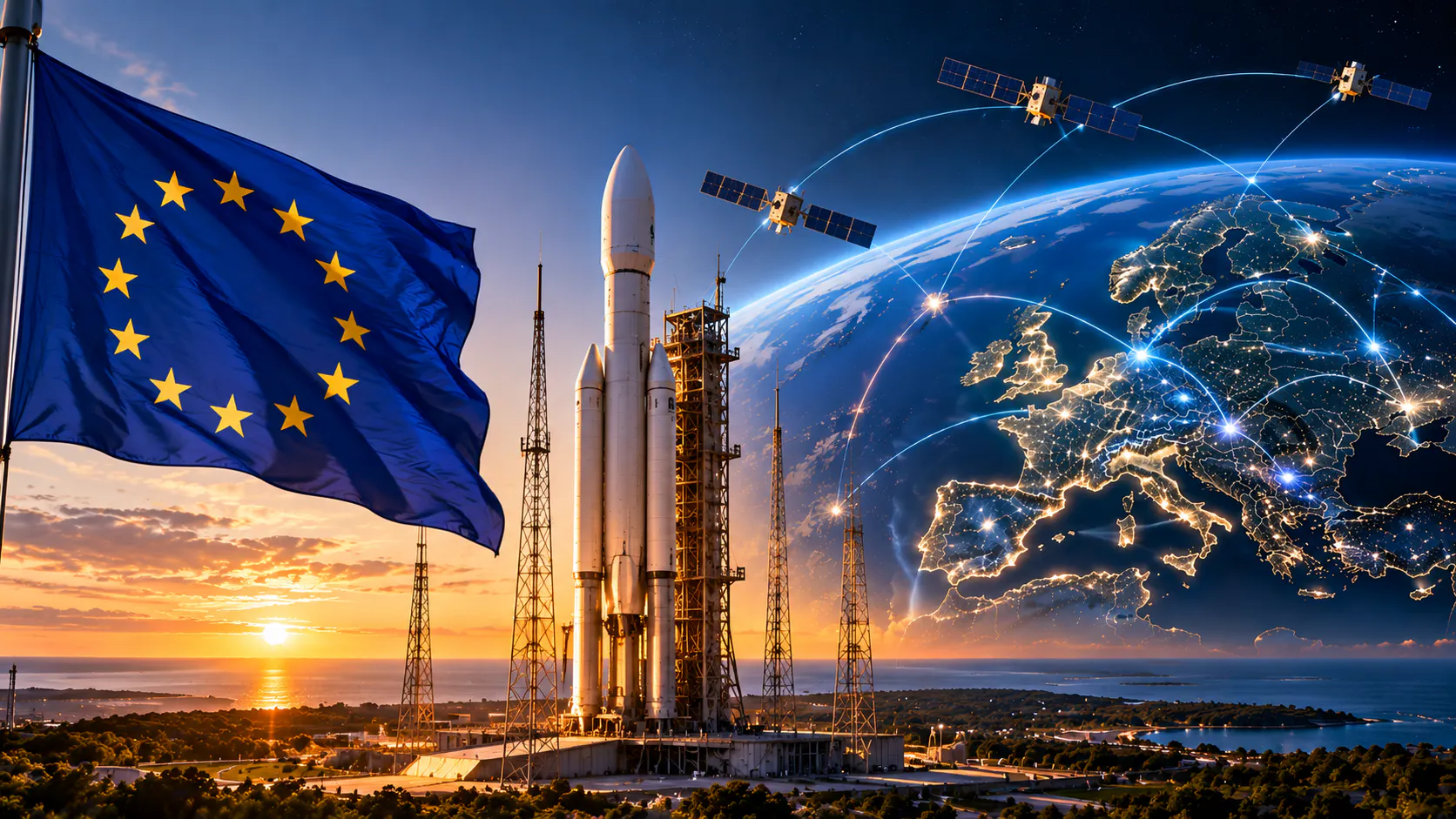
Europe launched eight rockets in 2025. SpaceX launched 170.
That comparison, cited by European Space Agency (ESA) Director-General Josef Aschbacher in August 2026, captures a problem that extends beyond launch statistics. ESA now expects European demand for launch services to peak around 2029–2031, driven by planned constellations and missions including IRIS², Galileo, Copernicus and national defence programmes. On the present trajectory, European launch capacity may not be sufficient to accommodate that demand, prompting ESA to examine whether Ariane 6 production could be increased from approximately 9–10 launches a year towards 15, alongside additional investment in Vega-C and other European launch capabilities.The difficulty is not simply that Europe has fewer launches than the United States. Europe has a functioning heavy-lift launcher in Ariane 6, the smaller Vega-C, established launch infrastructure in French Guiana and decades of experience in satellite manufacturing and operations. Ariane 6 itself returned Europe to autonomous access to space in July 2024 after the retirement of Ariane 5 and the earlier interruption of Vega-C operations. The problem is that European ambitions for satellite infrastructure have expanded faster than the industrial capacity available to place those systems into orbit, and IRIS² provides a useful example.
The European Union's secure connectivity programme was originally designed around a constellation of more than 290 satellites in low and medium Earth orbit, supported through a public-private partnership involving EU funding, Member State contributions, ESA participation and private-sector investment.The programme is now moving into implementation with an expanded architecture of 348 satellites, while the European Commission and the SpaceRISE consortium have brought the first launches forward to 2029.Galileo, Copernicus and national security programmes will compete for access to many of the same launch resources during the same period. The resulting pressure reveals an uncomfortable feature of European space policy: sovereign infrastructure does not necessarily produce sovereign access to the means of deploying it. A government can own the satellite system, control the data generated by it and establish the legal framework governing its operation, while remaining dependent upon a limited number of launch providers to place those assets into orbit. The retirement of Ariane 5 in 2023 was followed by delays to Ariane 6, leaving Europe without an operational heavy-lift launcher for approximately a year. During that period, European missions were redirected to foreign launch providers, including SpaceX. The episode did not eliminate Europe's technological capability, but it exposed the distinction between possessing the technical competence to build a launcher and maintaining sufficient industrial throughput to guarantee access when multiple government programmes require it simultaneously. The legal implications sit largely within European institutional arrangements rather than international space law alone. Launch activities remain subject to the national legislation of the state responsible for the launch and the relevant international obligations arising under the Outer Space Treaty, the Liability Convention and the Registration Convention. Article VI of the Outer Space Treaty requires States Parties to authorise and continually supervise the activities of non-governmental entities, while Article VII establishes international liability for damage caused by space objects. Europe therefore cannot treat launch capacity simply as an industrial commodity. The availability of launch services is connected to the ability of states to discharge their international responsibilities for activities conducted by public and private entities under their jurisdiction.
On the institutional front, ESA is an intergovernmental organisation, the European Union operates its own space programmes and regulatory instruments, Member States retain national competencies, and European launch companies operate commercially within that framework. Decisions concerning industrial capacity consequently involve several layers of public authority. A decision to increase Ariane 6 production, for example, is not simply a matter of ordering additional rockets. It requires demand forecasts, industrial commitments, financing, procurement arrangements and sufficient confidence that the additional production capacity will remain commercially sustainable. This is where Europe's current debate over launch capacity becomes a question of industrial policy. Ariane 6 has a substantial order book, including launches associated with Amazon's Leo constellation, while institutional missions provide another source of demand. At the same time, European policymakers must decide how much additional capacity should be publicly supported and whether that support should be concentrated on established launchers or distributed across emerging commercial providers.
The answer matters because the economics of launch have changed substantially since the architecture surrounding Ariane 5 was established. Reusable launch vehicles have altered the relationship between production costs, launch frequency and asset utilisation, while vertically integrated companies such as SpaceX can generate internal demand through their own satellite constellations. European launch policy therefore operates within a market in which the traditional model of sustaining a launcher through a combination of commercial and institutional missions faces a materially different competitive environment. To add to this complexity, there is a further issue concerning procurement. If European governments require sovereign launch capability for strategic programmes, institutional demand can provide precisely the baseline necessary to maintain industrial capacity. Yet excessive dependence upon government contracts can also insulate launch providers from commercial pressures. The policy challenge is to maintain enough guaranteed demand to preserve strategic capacity without creating a system in which public procurement becomes a permanent substitute for competitiveness.
That same question applies to new European entrants, where several emerging launch companies are developing vehicles intended to complement or compete with existing European systems. Their participation could diversify launch capacity, but introducing additional providers requires more than technological success. Launch regulation, spaceport access, insurance, spectrum coordination, environmental requirements and government procurement all influence whether a new vehicle can progress from a successful demonstration to a sustainable commercial service. Europe's predicament is therefore not accurately described as a shortage of rockets, it is instead a shortage of available, scalable and strategically reliable launch capacity relative to the infrastructure governments intend to place in orbit. That distinction matters because manufacturing additional vehicles is only one response. The longer-term solution will depend upon whether Europe can align its launch demand, industrial base, procurement system and regulatory framework sufficiently early to avoid another period in which ambitious satellite programmes are ready before the means of deployment are. Ultimately, and in conclusion, the decisions being considered now extend towards 2035. The significance lies in the launch infrastructure which cannot be expanded at the speed at which a satellite procurement contract can be signed. Production facilities, skilled personnel, supply chains, launch sites and regulatory systems require years of planning and investment. Europe's current warning therefore provides a useful reminder that space sovereignty is partly an exercise in industrial foresight. Access to orbit can be lost without a single launcher failing, simply because the capacity required several years later was not built when the demand was first identified. For Europe, the immediate question is consequently not whether Ariane 6 can launch successfully. It can. The more difficult question is whether the European launch sector can produce enough launches, across enough providers and at a sufficiently competitive cost, to support the strategic infrastructure that European governments are now planning. The answer will determine whether programmes intended to strengthen European autonomy reinforce that objective or remain dependent upon launch capacity outside the continent.